Raymond W. Brown
By John Deserto
Ray Brown, railroad historian, railfan and Middletown and New Jersey Railway employee was born on September 19, 1921, in Greenville, NY. Ray's mother was Hazel Breen Brown, and his father, Wesley Brown worked in the O&W shops at Middletown. The family home was very near the tracks of the Erie's Graham Line cutoff in Mount Hope, which provided Ray numerous freight trains to watch every day. The magic of the rails had enthralled young Ray by the tender age of two when he would kick up dirt with his feet to make "engine smoke".
In the mid 1920's the family moved to Johnson after the birth of a sister, Audrey. Wesley had turned from railroading to farming. It was here that the young Ray Brown first met the railroad that would be the focus of much of his life, the Middletown and Unionville. The Johnson elementary school was very near the M&U right of way and when trains passed, he would stand on his desk to get a better look out the window. Not surprisingly Ray got into some trouble in school, but the boy was definitely in love with railroading. The Brown's stayed in Johnson for about two years before moving to Kirbytown where his sister Dorothy was born. Eventually the family moved to Mount Hope along the Erie's Graham Line.
Past me here by the track them cars just flew...
It was in Mount Hope that Ray's first love, railroads, matured. The numerous Erie freights going by on a regular basis provided hours of entertainment for the young man. As a child, Ray would put ballast on the track but after he had left, playmate Herb Gordon Sr. would knock it off before the train arrived. His sister Audrey remembers how Ray would drop his ax and run off to the tracks while helping his grandfather cut wood near the tracks. He could hear the train before anyone else would hear anything, which for those of us who knew Ray later in life is truly astounding. Others remember Ray telling about watching his little sisters (the sisters remember it as tormenting) and in the rush to meet an oncoming train pushed his little sister (Dorothy) in a baby carriage down to the tracks. Ray would walk to Howells Station with his sisters to catch the Erie local train to Middletown High School, where he studied, among other things, Mechanical Drawing. Audrey remembers that a certain engineer would let Ray ride in the cab. He graduated from high school in 1940 at the age of 19, but was deferred from military service because of his developing hearing problem. This hearing problem is believed to be the reason Ray never got a job on the Erie.
After high school Ray worked for a time on Clarence Atkins' farm on Cottage Street Extension. One day Ray took a ladder over to the barn and climbed to the roof. Clarence assumed Brownie was going to do some repair work, however after not hearing any "work noises" he returned to see what Ray was up to. He found Brownie dangling off the peak with a camera. It seems that from the top of the Atkins barn the Erie's Graham Line was clearly visible. Ray became a journeyman carpenter during this time, finding his own work, being his own boss. He helped build a large number of barns in the area. Pete Rasmussen recalls that when out on the train, Ray would mention that he worked on some of the barns along the line. He built his own stone cottage that he lived in. He also dug graves and was a cemetery grounds keeper. Ray also had a tremendous love of dogs, he was caring for several dozen at the time of his death, most of them were adopted from the animal shelter.
Ray Brown, Modeler...
It was at this time that Ray's abilities as a model railroader blossomed. According to Jack Farrell, Ray built his first Erie Berkshire #3322 at the age of 12. Eight years later, while a member of the Kirbytowners 4H, Ray scratchbuilt an Erie Berkshire, #3324, which won a blue ribbon in the 1941 Middletown Fair. In Ray's description of how he built this model, he notes the use of prototype blueprints from ALCO, that all he purchased were unmachined cylinders, drivers, truck castings, screws and bolts. All the rest of the parts were fabricated from scratch using scrap metal and the metal working machines at the National Defense School in Goshen. The boiler was made from galvanized steel pails on a blacksmiths forge. The entire project took six months and ten dollars to complete. Ray continued to build live- steam, large scale models all his life (using machine tools he built himself) and later built a track around a pond at his home to run them on. He built another Berk #3322, his favorite, and many cars including 2 hopper cars, a reefer, gondola, flat car, and a caboose. Some of these cars were constructed of wood, others of metal. He also had an Erie GP 7, F7, and an unfinished K4b Pacific with just the wheels, frame, steam chest and boiler. He enjoyed giving his nephews and neighborhood children rides. The passengers are in their 40's now, and weeds and trees were growing between the rails at the time of Ray's death. The tracks have been removed and the models sold.
THE EVENING DRAG
by Ray Brown
On that warm August evening
There came the shrill call of the Whippoorwill,
While far way echoed the whistle
Of the lumbering freight down the hill.
I was never so content
At the close of a hot summer's day,
Than to sit there by the railroad track
With the fragrance of the farmers curing hay.
Louder and louder still
Came the exhaust of the hard-working-horse.
The headlight turned and swerved
As the train followed its course.
Then the light could be seen
Shining on the polished rail,
As the engine came strolling
Up the iron trail.
It was extra 3322,
The engine a monster Berkshire brute;
While along came the banging empties,
Swinging along the home bound route.
To watch that heavy drag,
It was the thrill of thrills,
As the powerful engine
Hauled those cars over the hills.
The train stretched into the distance
Where the grade began to go down;
And the train rolled onward
With its heavy drag home bound.
ERIE ENGINE 3322
by Ray Brown
Around the curves she comes, the thirty-three twenty-two.
Chugging and putting black smoke up into the blue;
There's tied to her tail a hundred and twenty cars flat,
And down there in the haze the little red hack.
But she handles them better than any engine could do,
For she's the best Erie engine, number 3322.
The engineer sits there with his hand on the throttle,
With his thoughts under his cushion on the empty whiskey bottle;
The fireman, he's got 3322 popping,
While around the curve she come a roaring and arocking.
Past me here by the track them cars just flew
For they were pulled by the good old gal, number 3322.
As I sit here on the railroad bank,
I am happy to watch each car go by with its clank-e-ty clank;
But last of all comes the little red hack,
And in a moment has disappeared up the track,
Leaving me here to think of that crew,
Who are on that caboose and the 3322.
The young man clutching his camera
Ray became a very serious railfan. His photo collection, as inventoried by Peter Brill after his death, contained well over 7,000 slides and many thousands more negatives and prints. Jack Farrell notes that the only form of photography Ray didn't try was motion pictures. From his thorough examination of the collection Peter concluded that Ray had two "eras" in which he was most active as a photographer. His first was as a young man in the 1940's shooting black and white prints of steam. With his home being located so close to the Erie it's not suprising to learn that a majority of his photos was of that subject. If you have any prints from Railroad Ave. Enterprises of Erie steam in the 1940's from Black Rock Cut to Goshen, you may have a Ray Brown shot. It seems that young Ray would borrow a friend's 35 mm Leica and shoot a huge amount of film recording the everyday action in his local area. Peter Brill found hundreds of these prints and some negatives in his collection. Ray would give/trade the negatives to John Stellwagen who made Ray 5-6 prints of each shot and he later stored them in his M&NJ payroll envelopes. Ray would then trade these shots with other fans for other prints. Stellwagen eventually sold the negatives to Bob Pennisi of Railroad Ave. Enterprises who made 8x10 prints of them. I had several hanging in my den before I realized they were probably Ray's. The total lack of O&W subjects from this era is explained by several things. First, the O&W's last steam engine was retired after July, 21, 1948. In contrast the more convenient Erie was running steam into the 1950's. Jack Farrell stated that Brownie shot no more than a dozen O&W steam photo's circa 1938, and they were of poor quality. He did purchase a vast number of O&W steam photo's. Many people tried to talk Ray into buying good cameras, very few were successful, but a quality photograph is what really counts and after some practice Brownie achieved this. Ray once called Jack to tell him about the new camera he had just purchased, a Chinese Pigeon. Jack wondered just who was the pigeon. Jack lent Ray some of Bob Harding's shots of the O&W and Oswego Midland. Bob's father worked for the O.M. and photographed it, as did Bob who worked on the O&W. Jack retrieved these after Ray passed away. Ray also acquired O&W photo's from Bob Morris, John Ahrens, Joe Lavelle, Jack Farrell and Bob Collins, as well as others. They also supplied him with Erie material.
Ray's collection of slides represents his second "era" and was voluminous. The vast majority of Ray's personal slides were shot during the 1961 - 1974 era and interestingly did not include such railroad hot spots as Warwick, Maybrook and Port Jervis. The largest category of subjects was, of course, the Erie Lackawanna. Ray had over 2900 shots of the E L in just about every location from Graham to Goshen on both the mainline and Graham Line including the branches at Pine Bush, Pine Island, Fair Oaks and Montgomery. This count also includes almost 700 steam era slides that were purchased or made from black and white prints, and does not include over 300 shots of freight cars in the Erie's Middletown Yard. The next largest part of the slide collection were about 1400 various rural, non railroad scenes. These included farms, sunsets, skies, houses, fires, street scenes etc.. The M&NJ was the subject of 1150 of Brownie's slides. Ray documented the M&NJ equipment very thoroughly during the 60's and 70's when the 44 Tonners wore the red schemes and the 103 steam engine was running excursions. Finally Brownie purchased over 1100 duplicate slides of steam on many other railroads. These railroads were as varied as the O&W and S&W to the D&RGW, UP and the Northern Pacific. This illustrates Ray's love of all steam engines and railroads, not just the local roads.
Ray also collected post cards and had assembled a vast collection of them. The subjects were varied from railroad scenes to excursion vessels, hospitals, court houses, and numerous other subjects.
The quality of Ray's work is also very impressive. In the sample of his photos that I have seen I'm struck by the way Ray could blend the scenery and non-rail related objects into the shot and achieve a harmonious and pleasing scene. He took hundreds of slides, not of just the head end, but also of cabooses, train consists and as mentioned, hundreds of freight cars in the Erie's Middletown Yard. By the time of his death he had half a dozen cameras or so. He always took lots of notes on train consists including engine and car numbers, which he diligently recorded into notebooks found in his personal effects. There is even a photo of Ray railfanning in front of the M&NJ station in Route of the Erie Limited on page 37. You can see him photographing 3 Erie RS 3's passing the station with a dead-head passenger train. His photo's have been published recently by the Erie Lackawanna Society in their magazine, The Diamond, and on the cover and as the November photo in the society's 1997 calendar.
Brownie was not always a "lone wolf" while railfanning. Ray would also enjoy photography with others and made numerous dawn to dusk outings with friends like Tom Kennedy, (M&NJ Road Foreman) Joe Kennedy's father, George Krumm and Bob Collins. George remembers:
"My earliest recollection of Ray Brown goes back to 1940 or 1941. I do not recall when I first met him or where but it may have been through Dick Prout who was one of my friends and lived near me. I was twenty years old in 1941 and assumed that Ray was a few years younger. He was very likable, non assuming and very interesting. If you had a question about the Erie, you asked him.
"One thing that stands out in my mind is picking him up at Slate Hill when we went on trips up to Susquehanna Pa. or just to somewhere on the Delaware Division. At that time there was no Route 17 Quickway, so to get to Starucca Viaduct by 8 am meant leaving North Jersey very early in the morning. Some of the fellows on these trips could be Prout, Bob Collins, Fred Neusser, Bernie Siems, Dick Loane and others, though not necessarily all at the same time. Usually we passed through Slate Hill just before dawn. It would be gray out, somewhat misty and the headlights still on. At that hour on a Sunday morning Route 6 was practically abandoned. As we approached Slate Hill I would peer through the mist for my first glimpse of Ray. We hadn't seen a single soul for the last 30 miles but sure enough Ray would always be there sitting among the milk cans on an old loading platform clutching his camera. We would pull over, open the door and he would climb into the back seat, squeezing in between the other fellows who were half asleep. After a stop at a diner in Port Jervis we would head up Route 97 in hopes of a good photo day.
"However it was not much longer for these trips. Soon the war started and with gas rationing, fellows going into the army, and taking pictures of trains arousing suspicion, these journeys soon ended.
"For awhile Ray was staying (visiting) with some relatives in New York City and he and Prout used to come over to my house to talk railroads and look at pictures.
"I am sorry to say I never saw Ray again after the war. In recent years I often thought of going to the railfan meetings in Middletown to see him but I never did. Now it is too late."
Bob Mohowski credits Ray with introducing him to the O&W in 1960. While passing the remains of the Burnside Diamond on a Lehigh and Hudson River Centennial excursion, Bob wondered out loud "What was that?""The O&W" replied a stranger in the crowd, Brownie was that stranger.
Ray also traded and bought slides and prints from many people to get earlier shots of his favorite roads and his beloved steamers. Peter Brill found letters to Ray that indicate that he was selling some duplicates of his E.L. shots. Russ Hallock purchased material from Ray and also took him on a trip to Steamtown in the mid-1980's. He stopped shooting slides in 1975, a full year before Conrail. Ray did shoot a few color prints but very few.
"We have to ask Brownie"
Ray will probably be best remembered as THE HISTORIAN of the M&NJ and other local railroads, which puts him in some very elite company along with Carl Detwyler, and Pete Rasmussen. Whenever a question had the rest of us stumped we could always count on Ray for the answer and usually the documents to back him up. Ed Crist acknowledged Ray's help in his book Erie Memories by saying "For a sheer wealth of knowledge, we doubt there is anyone to hold a candle to Ray Brown...his knowledge of Erie locomotives and equipment can only be called encyclopedic...there was no question, no matter how esoteric, that he could not answer." This was typical of Ray, always more than willing to share information, photographs, M&U Train Registers, O&W mechanical department records, etc.. Personally, Brownie answered several questions for me, especially when I was working on the Middletown, Unionville and Water Gap articles. Peter Brill relied on Ray for information a great deal, and was never disappointed. Ed Lewis wrote to Brownie in 1964 looking for M&U material, because he was writing a history of the line. Chris D'Amato noted that he wrote to Ray more than anyone else, on a great many subjects and that he was always willing to share info, pictures, etc.
Ray's collection included a vast amount of paper records of the local railroads and of steam engines in general. This was the basis for Ray's extensive knowledge of steam engines, and more impressively, he could find the information when he wanted it. He had a huge number of blue prints for steam engines and their accessories. These were donated to the O&W Society. The large number of books, railroad encyclopedias, journals, magazines, and some videos were sold by the estate to a book dealer. His sister Audrey donated a number of books and videos to the Society's lending library. John Milligan is in charge of this.
Chris D'Amato recalled how he met Ray. He and Bill Schaumburg visited the M&NJ in February, 1988. "I had visited the railroad once before, back in 1977, but it wasn't running and I had to settle for a couple of shots of the engine shed. This time, as we rode out over the line to clear snow from the switches, I saw that there was something special about the little road. Vowing to go back when the weather was warmer, Jim Ankrom and I headed back to Middletown the following May. It was one of those beautiful early spring days and the leaves were just popping out on the trees. We got some great color slides and chasing the train made me realize that the M&NJ was just loaded with that old-fashion "shortline mystique."
"After talking with Pete Rasmussen at the station, we headed over to the Middletown Historical Society, where we were told we could find Brownie. Whenever Pete had a question about the railroad that he couldn't answer, he always said, "Better ask Brownie."
"We found Ray down in the basement carefully scanning old newspapers from the 1800's for railroad items. This was something he said he often did. Ray was expecting us, and had us follow him to his home. The house was a tiny stone cottage that looked cute on the outside...the inside was filled with books, papers and railroad memorabilia....We found a place to sit-down in the living room and Ray pulled out photo albums filled with pictures of M&U, NYO&W and Erie action in and around Middletown. We headed back to New Jersey with a folder full of pictures that served as a solid foundation for the series. (Editors note: The Railroad Model Craftsman series on the M&NJ in the 1989-1990 issues)
"As Jim and I worked on the text, I often found myself writing to Ray Brown with specific questions about equipment, service, and industries along the line. While Pete Rasmussen and Carl Detwyler were also very instrumental in helping us put together the article and looking things over, it was Ray who provided the scale drawings of No. 6 (redrawn for us by Ed Gebhardt) and wrote the accompanying text. He also provided us with drawings and dimensional data for the Slate Hill depot; helped out with our 1940 trackplan by providing me with a good overall picture of what service was like at that time; collaborated with me on the text for the Middletown station article; and provided the erection drawings of the No. 7, which John Swanson worked off to build the model we featured in the final part of our series."Chris also noted "Sadly, when Ray passed away, he took a lot of local railroad history with him."
Jack Farrell long time friend of Ray also recalled his dedication to railroad history. They never met before 1960, even though they had mutual friends in George Krumm and Bob Collins for years. Jack , Editor in Chief of Locomotive Quarterly, states "Ray played an important role in its (Locomotive Quarterly) development" where he was the research editor for the last 20 years and whose writing style "would make any editor's day". It was here that we can perhaps see Ray's love of railroading most clearly in Ray and Jack's desire to preserve the photos and knowledge of regional and general steam era railroad history. A brief review of the Quarterly's back issues shows a strong presence of the Erie and O&W, but also southern, western and midwestern lines. The spring 1996 issue even has the M&U's complete roster in photos with text.
Locomotive Quarterly was not the only project during the 30 year friendship of Jack and Ray. An even more ambitious endeavor was the effort to research and record everything ever appearing in the Middletown papers about the O&W or its predecessor the Oswego Midland. This research was eventually to be included in a book that Jack and Ray were planning on the O&W. Ray would routinely visit Thrall Library and meticulously hand scribe material from microfilm into hundreds of pocket notebooks. These notebooks would be forwarded to Jack so he could type up the data and create a library on the line. This effort currently fills multiple file drawers and Jack is currently scanning this information into the computer to enable rapid location of the information. This project has taken years and Jack noted that Brownie's "patience and industry were remarkable". Other book projects, with many notebooks of information, were found in Ray's possessions. A two part manuscript on the history of the M&NJ and its predecessor lines, and what seemed to be a book about Erie steam engines that has quite extensive coverage of the early engines, with a roster and a listing of dispositions.
Ray's meticulous scribing saved a major piece of M&U history. Ray had copied the M&U General Manager's notes from the originals in the station. When the originals turned up missing in later years, Brownie's hand-written copies were the only thing left. These are typed and printed here periodically.
Ray was also active in other historical activities. He was a regular at O&W Society meetings and had a regular column, with Russ Hallock, in the O&W Society's Observer which featured a chronology of historic events on the O&W. This material was probably from his effort with Jack Farrell. While he was not a member of the Erie Lackawanna Society in recent years, he would ask Peter Brill for his copy of the society's magazine to read. He had a shot published in that recently.
Brownie was also active in the preservation of local railroad artifacts from equipment and railroads that were disappearing. Once on a railfanning trip with Tom Kennedy in Port Jervis, the pair came across a number of Erie steamers on the deadline waiting for the scrapper's torch. They waited until nightfall and borrowed some tools from a nearby garage and returned to "preserve" the number plates and whistles of several, soon to be departed, steamers. Ray also collected O&W Mechanical Department records by climbing through the shops windows after the O&W was abandoned. Thanks to Ray these records now reside in the O&W Society's Archives, where they belong.
Ray Brown, Romantic
As you have already noticed Ray was also a talented artist and poet. His romance with the rails was thorough. Ray also painted, and at least one example was purchased. Ed Horan bought a scene of two Erie engines double heading in the snow. In the poem, "Our Home-bound Trip" Ray again immortalizes his favorite Berkshire, #3322. This poem might explain his fascination with this graceful, beautiful powerhouse.
Our Home-bound Trip
By Ray Brown
The brakes were released,
And we pulled out onto the main;
And started our journey west,
With a heavy freight train.
A cool breeze was blowing,
As the day turned to night.
The lights of red, green and yellow,
Made this haven a railroaders delight.
Could there ever be more thrills,
Than to ride an engine at night?
It puts you to dreaming,
As you watch the oncoming sights.
The engineer opened the throttle
And the exhaust began to roar.
The fireman worked the stoker
Because the fire was eating more.
Our engine was a monster,
It sported the number 3322.
She was just from the shops,
And acted as good as new.
The bark turned into a chatter,
As we roared up the iron trail.
The smoke rolled over our heads,
Each crossing marked by the whistles wail.
The rails rolled out of the night,
And were swept by the headlights glare.
Then they were devoured by the wheels,
And went flying to the rear.
Each semaphore lunged before us,
Telling us the line was clear.
We left station after station behind us,
To reach our homes so dear.
Four hours had elapsed,
And we were rolling into our hometown.
We pulled into the yards,
Where the switchers were moving up and down.
They uncoupled the train,
Then we backed into the roundhouse.
Where the engine was put to bed,
And she was left quiet as a mouse.
Brakeman Brown
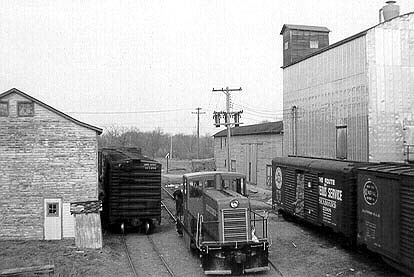
Brownie worked on the M&NJ on and off from 1961, and retired from the railroad in 1986 at the age of 65. Most of Ray's employment on the M&NJ was part-time, as he spent the other time working as a grave digger and caretaker for Pine Hill Cemetery at Bradley's Corners. M&NJ owner and former engineer Pete Rasmussen remembers fondly the time spent working with "Brakeman Brown" and noted that he could pull out old ties and replace them single-handedly. This is quite a feat for those who have leaned into one side of a pair of tie tongs. In the early 60's Ray was doing track work when the regular track gang needed him, usually when they were working far down the line and it took more time to travel to the work location. Ray worked this gang with Ray Hummel, an ex O&W man and Frank Furman, a true old timer who fired camelbacks on the M&U in the 1920's. His name also shows up as fireman on the M&U 1941 train registers in the last issue of The Unionville Flyer on the coal traffic.
One day, Pete and Ray played a little joke on a fellow crew member. It seems that he could be a bit of a pain, and had an odor problem because he seldom bathed. Ray called him "stinky pants". One Saturday in 1979 or 80, Pete, Ray and "stinky pants" were retrieving some of the blue NRUC boxcars from storage in Westtown. No one recalls just what "stinky pants" had done but Ray and Pete had had enough. Pete coupled on to the string of stored boxcars and Ray told "stinky pants" to pull the pin on the 11th car, which he did. Meanwhile Ray snuck out and uncoupled the 10th car. Pete pulled out with 10 cars and "stinky pants" watching from the 11th as the train left him behind. Pete and Ray got to Middletown, dropped the cars and had a leisurely lunch before returning for poor "stinky pants" , who walked from Westtown to Slate Hill before being picked up by the returning crew. The whole thing was witnessed by a volunteer track crew made up of members of the Morristown and Erie and the Morris County Central.
Upon his retirement Ray continued to visit the Middletown station daily and sometimes went out with the train on an afternoon trip to Slate Hill, sitting in the fireman's seat. After one of his daily visits to Thrall Library for research, he would stop for lunch at Lloyds, then visit the station on his way home. If he had included Tom's Hobbyshop on the drive he would pick up and share a railfan magazine, a new book, apples if they were in season or whatever information his research had provided to the crew at "M&NJ headquarters". He sat opposite Edith's desk in that squeaky swivel chair and read anything Pete had for him. It was during this afternoon period that Ray would take a trip down the line to Slate Hill if the train was running that day. If it was, he would, and after filling a two liter Pepsi bottle with water, Ray would enjoy the ride from his old perch on the fireman's side. He had a standing joke with the train crew that if it was raining he would ask if they were going to Slate Hill.
Pete Rasmussen remembered that Ray was a good carpenter. He had worked as one for a while, and was good with diesel locomotives, but the same could not be said about his automobiles. His first car was a blue 1937 something or other, but later on he drove mostly pickup trucks. Pete could always count on Ray showing up on Saturday while his car was being fixed at Lloyds repair shop. He also remembers one of Brownie's trucks had problems with the distributor and after lifting the hood he saw blue flames shooting up and down the spark plug wires. Ray was not impressed with the frailty of the automobile. Another truck that Pete looked over had the wiring connections dangling over the wheels after the wheel wells rotted out. The former carpenter put roofing tar on the wires. Problem solved. Ray would typically buy a truck, run it into the ground, park it in his yard and buy a new one. Several of his abandoned vehicles were used to store O&W records in addition to two sheds on his property. He obviously didn't hold the automobile in the same high regard as a locomotive.
Due to Brownie's retired employee status he was awarded an honorary membership in our Society at its creation. He never missed a single meeting which is all the more impressive when you realize that he couldn't hear any of it. Ray even began showing some of his slides at one of the last meetings. We were looking forward to seeing more with his knowledgeable narration.
Epilogue
I myself never really got the chance to know Ray as well as I wished when he was alive. I could never quite raise my voice enough to have him hear me. Respect I guess. We were beginning to write back and forth some, then like George Krumm said, it was too late. We will all miss his tremendous devotion to local railroad history. Now he's the young boy sitting by the tracks smelling the fresh cut hay, watching the #3322 storm up the hill on a perfect summer day. Ray will be missed like the engines and the railroads that he loved so much.
I wish to thank Audry Brown, Peter Brill, Chris D'Amato, Jack Farrell, George Krumm, Bob Mohowski, and Pete Rasmussen for their help in researching and editing this biography. They made this a very rewarding experience for me.
Additional Information: As I'm sure we all have experienced, after completing some project for an extended amount of time, some additional information appears that would have been very useful but it's too late to alter the finished result. Usually this occurs to me in the modeling aspect of railroading. Well this time it was in the historical aspect, it was bound to happen sooner or later. About two weeks after the last issue was mailed, Peter Brill found a newspaper clipping from the Middletown Times Herald dated August 12, 1938. Its titled "High School Senior Finds New Use for Discarded Tin Cans" and it details a 16 year old Ray Brown and his construction of a model Erie Berkshire for the 1938 Orange County Fair. The article includes the photo we included on page 5 of the Unionville Flyer. In that issue we mentioned Ray's model of an Erie Berkshire that won a blue ribbon in the 1941 Orange County Fair. We had no idea that there was a prior entry to the blue ribbon effort. The 1938 article mentions not only the model, which took him 20 months to complete using a workshop in Mrs. C.W. Mould's barn a half mile from his house, but also a great deal of other information about Ray. The family moved to Mount Hope from Johnson in 1934 when Ray was 13 years old. Ray spent a lot of time talking to the crews of local trains, and according to the newspaper this earned him the nickname "Casey Jones" by the Erie crews. It also mentions Ray's determination to become an engineer on the Erie or some other railroad, which we know would be an unfulfilled dream. Ray was also involved in the Railway Camera Club of New York City at this time and had been a member for the last two years. It was also mentioned in the clipping that Ray's father had been an engineer on the O&W, something that we couldn't confirm from other sources.
Additional Ray Brown information came from Charles Krumm who knew Ray in the early forties and was quoted in the Unionville Flyer article. He wrote an additional letter to Peter Brill about Ray. Charles notes that after a great deal of thought he remembers Ray used an old Kodak box camera, which ironically had the nickname of "brownie" although he never heard anyone call Ray "Brownie", he must have picked this up later.
Originally printed in Vol.3 #3 of the Unionville Flyer
