The Story of the "Brass Top" lantern
by George Shammas
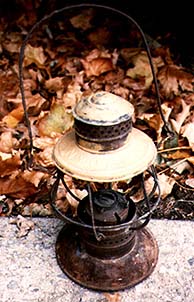
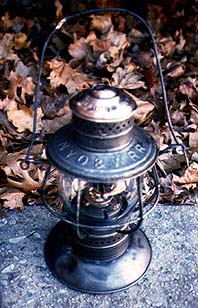
The Ontario & Western lantern featured here is seen in both before and after conditions. It is probably the best piece in my collection, and it is very unique. I call it "the cornerstone of my collection" and the story that goes with it and the theory about it is very interesting, and is as follows.
First the story...Back in the fall of 1990, I received a phone call from one of my longtime friends, who is a State Trooper and lives in the Middletown, N.Y, area. It regarded an O & W lantern that a fellow Trooper found while cleaning up the basement of his Campbell Hall. N.Y home. He asked me if I wanted it, and of course I said "Sure, how much? He replied, "It's free, it's yours if you want it". So, on his next trip to the old neighborhood in Brooklyn, I met him and took the lantern.
At first look, I was very disappointed. Its condition was poor as it was very rusty, dented and painted on. I began to work on it and after I stripped the rust and paint off, I delightfully discovered that this was a "brass top" lantern, and was very rare: Many days of scrubbing, filling in, dent removing and clear coating for rust protection were done in order to get it into the condition seen in the "after" photo.
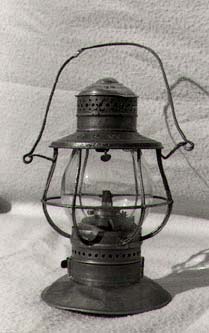
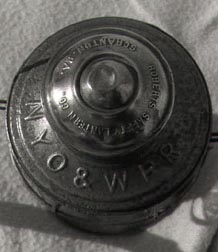
Next the facts...Next, the facts... This lantern is the product at the Roberts Safety Lantern Company of Scranton, PA. However. it also has stamping from the C.T Hamm manufacturing company, which suggests that it was made by the latter company for sale by the former company. C.T. Hamm also had it's own line of lanterns for sale to the railroads. The Roberts safety lantern was different, however. It boasted the unique capability of lighting the lantern without disassembling it, or using a match. It incorporated the use of a flint mechanism near the burner inside the globe. A hole in the bottom of the lantern leads to a groove that runs up the fuel pot to the burner. It is believed that the Conductor or Trainman could light it by using some sort of tool inserted into the hole to operate the flint mechanism.
This lantern is different from other "bell bottomed" lanterns in that is has double vertical wire guards and only one horizontal guard. Later bell bottom lanterns featured single vertical wire guards and two horizontal guards, Also, the bell and the fuel pot are one piece. and are removed from the bottom for servicing. On the lid, the railroad is represented with large, raised letters measuring 5/8". Future lanterns would have smaller letters. The height of the globe is 5 and 3/8", which is shorter than the 6" globes of later lanterns. Finally, the top piece or smoke cap is made of brass so as not to rust. Later lanterns were produced without the brass top for economic reasons.
Now the theory... The patent date of this lantern is June 10. 1889 and was manufactured in Scranton, PA. Coincidentally, The New York, Ontario & Western Ry. arrived in Scranton in 1890 after completing the construction of its Scranton Division line from Cadosia, N.Y. As evidenced in my collection and the collections of our fellow members, the O & W purchased bell bottom lanterns of that time period and later from other manufacturers such as Star Headlight, Steam Gauge, Dietz and Adams & Westlake. As of now, this lantern is the only one of its kind known to exist, and it is believed to be a salesman's sample brought to Middletown. N.Y. for presentation to the Purchasing Department. Roberts Safety probably felt that since the O & W came to Scranton. it could try to get some of the lantern business from them.
It seems the railroad never purchased these lanterns. Possibly because of the cost or the unconventional way of lighting them, or both. I like to think that maybe the salesman left it wlth the Purchasing Department to further ponder its decision and that somehow it wound up in the hands of an employee who decided to bring it home and store it in the basement of his "on-line" Campbell Hall home in case of emergency or power failure.
In any case, the possibilities are endless, and whatever events took place in the past, the fact remains that this lantern is prized by me and it found a good home in my collection. I take pleasure in sharing this story with you and I thank you for your attention.
Before |
After |