"The Pony Express"
by Robert E. Mohowski
Americans' sense of identity is filled with legends, the popularized understandings of historical events which frequently contain misinformation. To question them, to suggest or offer contradictory historical fact, can easily result in placing one's patriotism and loyalty in question. So politicians, Hollywood and those who see a buck in them continue to quack them out and perpetuate a mythical American past. (The symbolic "Marlboro Man" as a legendary cowboy serves as a common example.) I don't think the story of the Pony Express has fared any better or worse than the average but I do remember a frequently reproduced painting showing a rider's saddlebags incorrectly labeled, U.S. Mail. The Pony Express was a private enterprise established by the freighting firm of Russell, Majors and Waddell in 1860. It operated for a short 19 months and was not a financial success, even with the cost of each letter carried running between $10 and $15. Yet it quickly caught the nation's attention and imagination. It is probably as sacred a symbol as the Minuteman, the Rough Rider and Casey Jones.
Please don't mistake me, I know that this is very serious stuff and am just as fascinated by the legends and that's why it's such fun to search for the reality (whatever that may be) behind the image.
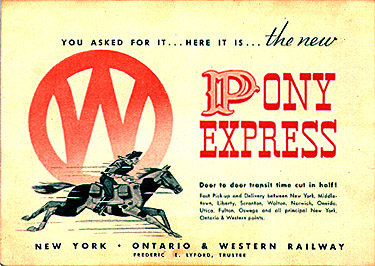
The Florist Telegraph Delivery (FTD to most folks) took a risk when they chose the image of Mercury, the Roman messenger of the Gods, to be the symbol of their rapid service. Is Mercury or Hermes (the Greek version) as expressive a symbol as the Pony Express Rider? Certainly not for a red-blooded American! Mercury lacks American national identity. Ancient mythology did not have six-guns, the Great Plains, broad-brimmed hats and Indians of our own nineteenth century, and the O&W certainly knew it! None of that effete European stuff for lower New York State! When the railroad introduced a new freight service in 1939, it had a masculine resonance and the promotional material made sure that impression got out to the public.
The O&W's "Pony Express" was a service and not a train in the sense that the Union Pacific's passenger train of the same name was. The image presented to the shippers was for a rapid, package freight service something on the order of today's UPS or the old Railway Express Agency. It offered pick up and delivery between selected major towns and cities on the railroad including New York City, Utica and Scranton. Most, if not all of this business was less-than-carload traffic that was handled in boxcars and could be very profitable in large quantity. However it was very competitive and highly sensitive to delays or even a hint of unreliability. The railroad made arrangements with trucking companies for local pick-up and delivery and across-the-platform transfer sheds were used as exchange points.
The O&W inaugurated its "Iron" Pony Express on July 24, 1939. Shippers would call to have their packages picked up before a "closing time." Initially this was 4:00 PM for Manhattan, 3:00 PM for Brooklyn and other times for other points depending upon distance from Weehawken. At the latter point the shipments were loaded into merchandise cars, clean and well maintained boxcars bearing the O&W's own name to save car hire costs. By the 7:30 PM departure time cars had to be sealed and all paperwork completed and handed to the conductor. Train WA-1 then got underway and everyone involved with the operation tried to get the train over the road in accordance with the schedule (or better if possible).
At scheduled stations, cars would be dropped off for unloading and the freight packages would be called for or delivered. Since this was a premium service, the charges were higher than those for regular freight. It is not likely that WA-1's train was ever a solid consist of this express business since the upstate communities were comparatively small. On the other hand, the Pennsylvania, New York Central and Erie and other trunk lines made up whole trains of package business daily for Buffalo, Cleveland, Pittsburgh, Chicago and St. Louis. Such trains ran on some of the fastest schedules posted for their roads. Still, the difference between the O&W and these larger roads in this service was one of quantity, not quality. The Pony Express was one of Trustee Frederic Lyford's projects to offer a useful service and bring in dollars from all possible sources.
PONY EXPRESS SCHEDULE
NORTHBOUND
(Read Down)TRAIN
No.
WA-1STATIONS
Train
No.
AW-2SOUTHBOUND
(READ UP)7:30 P.M.
Lv.
Weehawken, NJ
Ar.
10:10 A.M.
next day
same day
10:20 P.M.
Ar.
Middletown, NY
Lv.
6:41 A.M.
next day
next day
1:05 A.M.
Ar.
Liberty, NY
Lv.
4:25 A.M.
next day
next day
10:10 A.M.
Ar.
Mayfield Yard, Pa
(See Note 1)Lv.
2:30 P.M.
same day
next day
7:05 A.M.
Ar.
Norwich, NY
Lv.
10:30 P.M.
same day
next day
9:12 A.M.
Ar.
Utica, NY
(See Note 2)Lv.
5:00 P.M.
same day
next day
10:00 A.M.
Ar.
Oneida, NY
Lv.
6:40 P.M.
same day
next day
11:30 A.M.
Ar.
Fulton, NY
Lv.
4:40 P.M.
same day
next day
12:00 Noon
Ar.
Oswego, NY
Lv.
4:00 P.M.
Note 1- Northbound Train No. WA-1 to Cadosia, NY, and US-2, Cadosia to Mayfield Yard, Pa handles merchandise for all Scranton Division points, Carbondale to Scranton, inclusive. Southbound via Train SU-1 to Cadosia and AW-2 to Weehawken.
Note 2-Utica freight handled Northbound in Extra from Norwich to Utica-In train US-2, Southbound from Utica to Norwich.Thanks to James N. Parrella for materials and the Pony Express Stables Museum in St. Joseph, Missouri.
Passenger Extra South
by Robert E. Mohowski
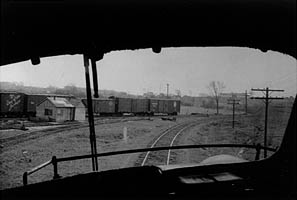
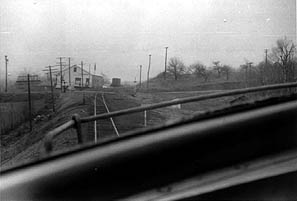
In April, 1950, an inspection train covered the O&W's main routes in New York and Pennsylvania. An F3's 1500 horsepower was sufficient for what most likely was a two or three-car consist. Here we have a fireman's view as the passenger extra leaves Oswego. The purpose of the trip is unknown but it had to have the approval of the trustees' office and the bankruptcy court. The trustees could have been looking over the condition of the property or may have had prospective customers on board to look at industrial sites that would require rail service. If this was a company inspection trip, heads of the various maintenance-of-way departments would be aboard to review the condition of track, roadbed, bridges, and structures. The information would then be used to plan where scarce funds would be spent on the year's maintenance projects.
A review of current freight service schedules and work assignment might be included. A run might be abolished, created or its hours of service changed. Changing levels of business and service requirements meant a fairly frequent review of operations to meet customer demands in ways that wauld be the most economical and efficient for the cash-strapped railroad.
Above: If we were to look back from this side of the cab, we would see the enginehouse and limited facilities at this northern extremity of the O&W. Also behind us are the rails that lead into town, the harborside terminal and connections with the New York Central (former RW&O) and the Lackawanna. Less than a mile off to the left, Lake Ontario stretches to the northern horizon and the Canadian shore.
Several hundred miles and a day later, we are looking geographically north approaching Pleasant Mount, Pa. The two-story station is gone and the railroad rents a small office in the GLF building west of the track. Across from this but not visible, is the Dairymens' League plant which may still be using rail service at this time. The right-of-way here is now a recreational trail and is especially popular with snow mobilers.
BOTH PHOTOGRAPHS: Walter Rich Collection.

BX Tower
by Robert E. Mohowski
Structures like this two-story example at Bloomingburgh (later known as High View) were known by various names. On the New Haven and New York Central they were signal stations, on the D&H they were cabins, the Erie and many other railroads called them interlocking towers and the O&W simply called them towers. Their purpose was to control switches and signals in accordance with the timetable, and dispatchers' orders. They might also issue train orders and clearance cards and act as manual block stations to space trains. The signalman or operator was permitted some
discretion, within operating rules, when local switching was necessary.
Here, near the south portal of High View Tunnel is BX tower. Along with WX tower at the north end of the tunnel, its purpose was to control the single track through the tunnel by communication between towers and the dispatcher for each train movement. The letters "BX" and "WX" refer to the telegraph call letters for these locations. Towers would usually have names or their telegraph call letters displayed in windows or on the side of the structure but at this time BX is missing such identity. (Long after telegraph communication was replaced by telephone and radio, railroaders still referred to many locations by their old call letters.)
Note the light colored, wooden cover over the pipes and rod connections just below the two lower windows. The pipes and wires extending from this box were the connections to switches, derails and signals within this particular interlocking "plant." The word "interlocking" is used because the various components were so constructed that conflicting routes could not be set up by mistake. If we look at the southbound signal, we can see it is clear for a move in that direction. It would not then be possible to give a proceed signal to a northbound train.
Before an employee could work here or at any other tower, he had to qualify or post. This meant observing a regular working towerman for a few days to learn the characteristics of the plant and how the various train moves were set up. A rules examiner or other supervisory personnel would eventually "OK" (qualify) the person to work at that location. Usually signalmen were qualified at several locations and after they had accumulated enough seniority, they could "bid" to "own" a regular job at one location.
Signalmen often worked at some distance from home and would commute to work on a company pass if passenger trains were convenient. If not, in the days before automobiles, they had to board at a local farmhouse or have a room in town. As train control and dispatching technology advanced, fewer towers were needed. Signalmen's jobs became more scarce and only the more senior men could hold them. BX went out in the late 1930's when the O&W went to Centralized Traffic Control (CTC). The operator at Summitville took over the tasks of BX and WX at High View Tunnel and Neversink tower at Fallsburgh Tunnel and thus consolidated four control points into one.The background in this photograph offers some interesting details. On the far siding are some work outfit cars and the siding next to the main holds a milk car. There is a gazebo-like structure north of the station and beyond that is the roof and chimney of a sectionhouse. At the time of this photograph, the location was listed as Bloomingburgh in the timetables. Later it was changed to High View, perhaps to sound more appealing to summer vacationers. Photograph: O&WRHS/ 8/97
Red Order Board at "RY"
by Robert E. Mohowski
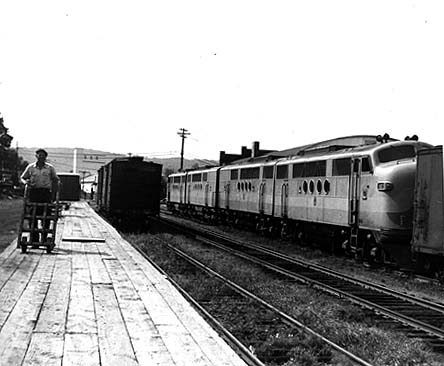
The noise of squealing brake shoes, chattering rods and groaning draft gear finally ceased when four FT's brought their slow moving northbound train to a stop opposite the Liberty freight house and transfer platform. In automatic response to the horizontal semaphore blade in the distance, the engine crew had been voicing unflattering opinions on the dispatcher's professional ability, his family ancestry and his poor treatment of a crew that's eager to get home. Good railroaders that they are though (and probably following a company edict), they have stopped short of a busy grade crossing.The head brakeman climbs down from the cab and walks up to the Station to find out what's going on and how long they are likely to be held. There is a passing siding here at Liberty but the stop signal ahead has been manually set so this is more than a simple meet in CTC territory.
Train crews were used to this sort of thing and their outraged indignation was pure reflex action. Under these circumstances they knew where the restaurants and other time-passing diversions were located. In each town along the line a crewman may walk down the hill, perhaps to Katz's Bakery for a fancy confection and if he's in a generous mood, he might treat the head end crew. The rear end crew in the caboose would not fare as well. Stuck in the woods perhaps a mile or so south of town in the days before railroad radios they could not stray too far from the train unless they knew for sure that the delay would be a long one.
Motorists will be intimidated by the proximity of the train to the Lake St. crossing and even though the flashers are cut the flagman will have to wave them over while they nervously look up and regard the idling diesels. Children will ask why the train has stopped and will probably receive a vague answer from adults who have no more an idea of what's going on than the children do. The major difference is that the grown ups feel fortunate to have missed a delay in their schedule. But if dad himself is driving and likes trains, there is a chance he'll pull over and stop to talk to the crew. I can picture the scene quite clearly for I was often a participant at other places and in other times. A grandfatherly engineer looks down from the cab window and asks, "You boys ever been up in one of these?" The curious, wistful looks of a father and son would not be ignored and once the"C'mon up," was heard, it would be difficult to tell who climbed into the cab more enthusiastically.
Once in the locomotive, they receive an often excited explanation of the handles, switches and gauges. After a while engine 118 rolls past, with the "AV-HD Pickup" after having finished the Liberty work. Soon the order signal clears and the guests have to leave..."climb down backward son, stick those old train orders in your pocket now and hold the rails with both hands...be careful."
The locomotive bell clangs, brakes are released and two short horn blasts alert the crossing watchman to stop traffic. Sixteen exhaust stacks then shoot out blue smoke as the gray and yellow diesels once again call attention to the O&W's usual place in the village's scheme of things. A farewell wave from the cab and all resume the interrupted flow of their afternoon routines. 07/97
Photo courtesy of Rusty Recordon